

Most practices we assess already own the capability to earn considerably more than they currently do. The constraint is almost never clinical.
There is a pattern we see in almost every practice assessment. The diagnostic equipment is in the building. The physician is trained and willing. The referral base exists. And the service runs at a fraction of what it could, because it was never set up as a program.
A piece of equipment produces revenue only when six things are true at once. Most practices have three or four of them.
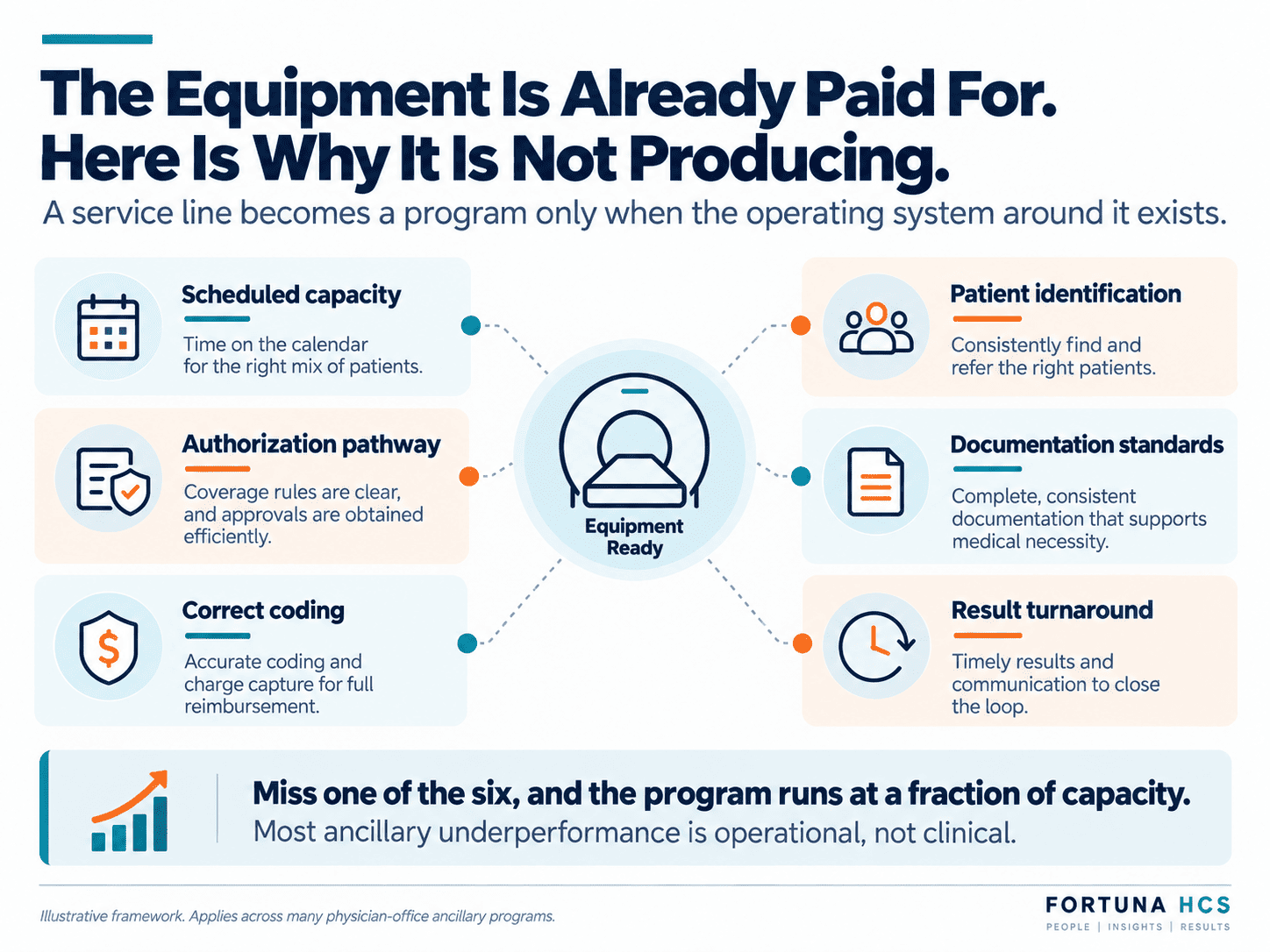
What a Program Actually Requires
- Scheduled capacity. Dedicated slots on defined days, not squeezed between clinic patients when someone remembers. If the study competes with office visits for the same slot, the office visit wins every time.
- Patient identification. Somebody deciding, systematically, which patients on tomorrow's schedule are candidates. Left to the moment of the visit, this depends on the physician remembering during a fifteen-minute appointment.
- The authorization pathway. Which payers require it, what documentation supports medical necessity, who submits it, and how far ahead. This is where most ancillary programs quietly die.
- Documentation standards. What the note must contain for the study to be payable and to survive a review. Written down, not held in one person's head.
- Correct coding. Technical and professional components handled properly, units supported, modifiers applied. Small errors here scale badly across volume.
- Result turnaround. A study that takes three weeks to read stops being ordered, regardless of how good the equipment is.
Miss any one of the six and the program does not fail loudly. It just runs at a third of its capacity, and everyone assumes demand is the problem.
Why It Looks Like a Demand Problem
Because the symptom is an empty schedule. The equipment sits idle, so the conclusion is that patients do not need the service or referrers are not sending them.
Occasionally that is true. Far more often the demand is there and the practice cannot convert it — the slot did not exist, the authorization was not started early enough, the candidate was not identified before the visit ended.
The test is straightforward: look at how many eligible patients passed through the practice in the last quarter, and compare it to how many studies were performed. If the first number is a multiple of the second, the constraint is operational.
Where to Start
Pick the service line with the largest gap between eligible patients and completed studies, and build the six elements around that one. Do not attempt all of them simultaneously — a half-built program in four service lines produces less than one working program.
Once the first one runs properly, the pattern is transferable. The scheduling logic, authorization workflow and documentation discipline are largely the same whether the study is an EEG, an echocardiogram or an ambulatory monitor. The clinical content differs; the operating machinery does not.
The Wider Point
Ancillary revenue is usually discussed as an expansion question — what should we add? For most practices the better first question is what they already have that is not running.
Capability you already own, with equipment already paid for and a physician already trained, is the cheapest revenue available to a practice. It just needs to be operated rather than offered.
You do not need another report telling you that something is wrong. We help identify the operational cause, build the solution, and stay accountable for the result. The assessment fee is credited against your first invoice if you engage us.