

Revenue that does not depend on clinic capacity is genuinely attractive. It is also a staffing commitment with a margin, and the margin is calculable before you start.
Chronic care management, principal care management and remote therapeutic monitoring share an appealing property. They generate revenue that does not require a provider to be in a room with a patient. That makes them one of the few genuine ways to grow a practice without adding clinic hours.
They are frequently described as passive revenue. They are not. The payment arrives monthly because the work happens monthly, and the question that decides whether a program is worth running is arithmetic, not coding.
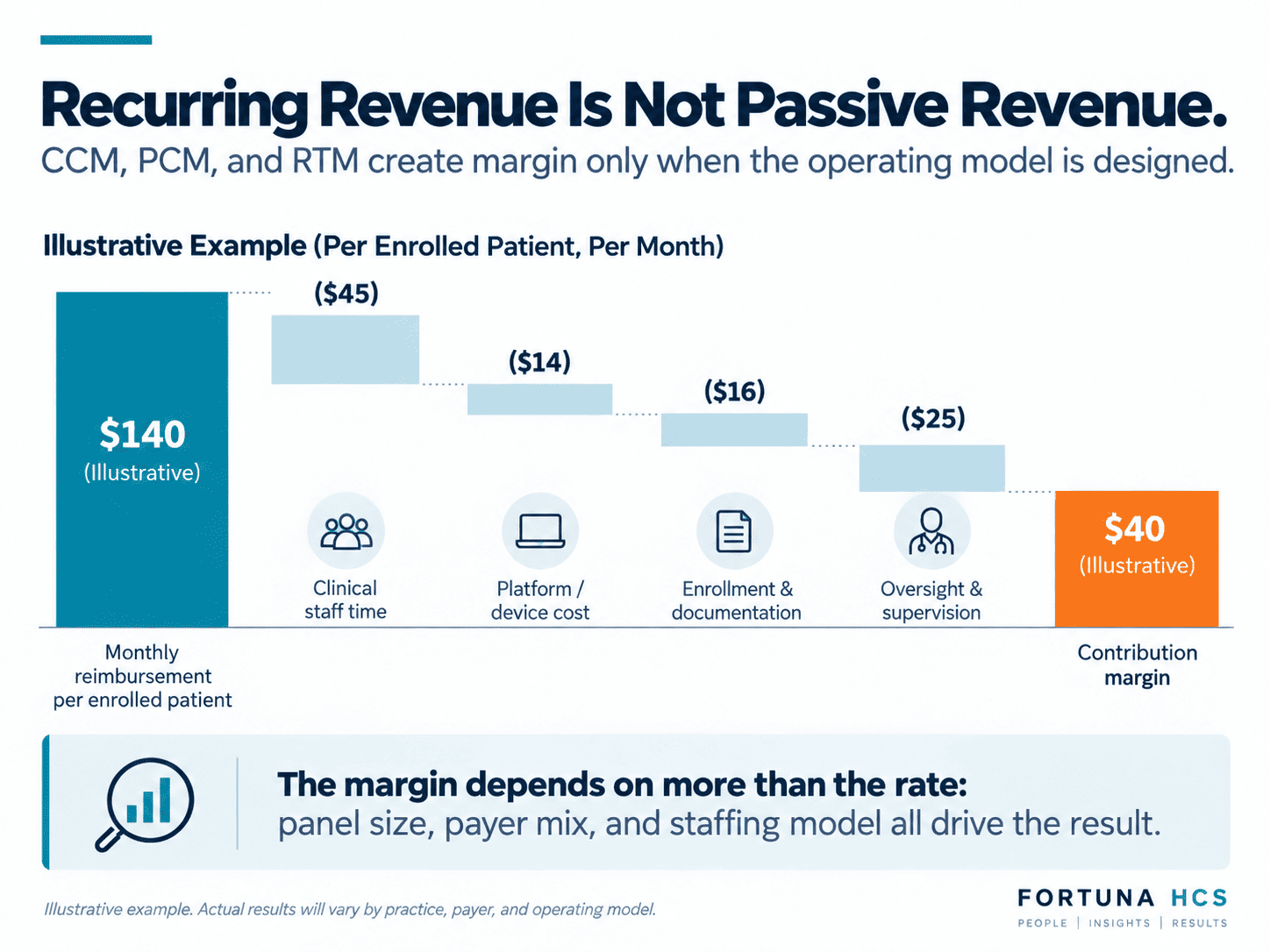
The Unit Economics
Every line under the reimbursement is a real cost that recurs every month alongside the payment. Clinical staff minutes at a loaded rate, not a base hourly wage. The platform or device. The enrollment and documentation work, which is heaviest in the first month per patient and never reaches zero. Oversight and clinical review.
The graphic above works a single illustrative month. A monthly reimbursement, less clinical staff time, platform or device cost, enrollment and documentation, and oversight, leaving a contribution figure. Run the same arithmetic with your own rates and your own loaded staff costs before committing to a program.
What remains is contribution per enrolled patient per month. That figure is what you multiply — and the multiplier is the number of patients you can enroll and keep enrolled, not the number who are eligible. Eligibility is a characteristic of your panel. Enrollment is an operational result, and the gap between the two is the whole question.
Where the Math Goes Wrong
- Enrollment is treated as a conversation to have during a visit rather than a list to work. The program stays small, the fixed costs do not, and contribution per patient stays negative.
- Staff minutes are costed at wage rather than loaded cost. The margin looks real until the program is staffed properly.
- Minutes are worked but not documented contemporaneously, which is the same as not working them the moment anyone asks.
- Nobody owns the program. It is absorbed by a nurse between rooming patients, and it produces neither the revenue nor the care.
Run It Before You Build It
Model the contribution per patient, then model it again at three panel sizes: the number you can enroll in 90 days, the number at a year, and the number at full scale. A program that only works at full scale is a program that loses money for a year first, and that is a decision worth making deliberately rather than discovering in month eight.
The Control That Catches What Reports Miss
Reconcile scheduled encounters against billed encounters, weekly. Take the completed visits on the schedule for the week, take the charges posted for those same dates, and compare the counts by provider and location.
A charge lag report shows you claims that went out late. This reconciliation shows you the encounters that never generated a charge at all, which no lag report can surface because the claim does not exist to be measured. Those are usually procedures, hospital work, injections and same-day add-ons — and they are found during an audit if they are not found during a weekly count.
One Caution
Care management and remote monitoring are active audit areas. Programs are examined on consent, time documentation and the clinical substance of what was delivered. Build those controls at launch. Retrofitting documentation standards onto a program that has been running for a year is considerably more expensive than setting them up correctly at the start.
The Operator’s Check
| Measure: | Contribution margin per enrolled patient per month, and enrolled patients as a share of eligible patients |
| Owner: | Program lead, with the practice administrator on the economics |
| Cadence: | Monthly |
| Red flag: | Enrollment flat for two consecutive months, or contribution per patient falling as the panel grows |
You do not need another report telling you that something is wrong. We help identify the operational cause, build the solution, and stay accountable for the result. The assessment fee is credited against your first invoice if you engage us.