

A practice can raise its prices, collect more money than ever, and watch its collection rate fall through the floor. That is not a failure. It is a measurement problem.
Most practice owners we meet track one collections number, and it is usually the wrong one.
Gross collection rate is payments divided by charges. It is easy to calculate, every system reports it, and it is close to meaningless — because you control the denominator. Raise your fee schedule and your gross collection rate falls, even if nothing about your billing changed. Lower it and the rate rises, even if you are leaving money on the table.
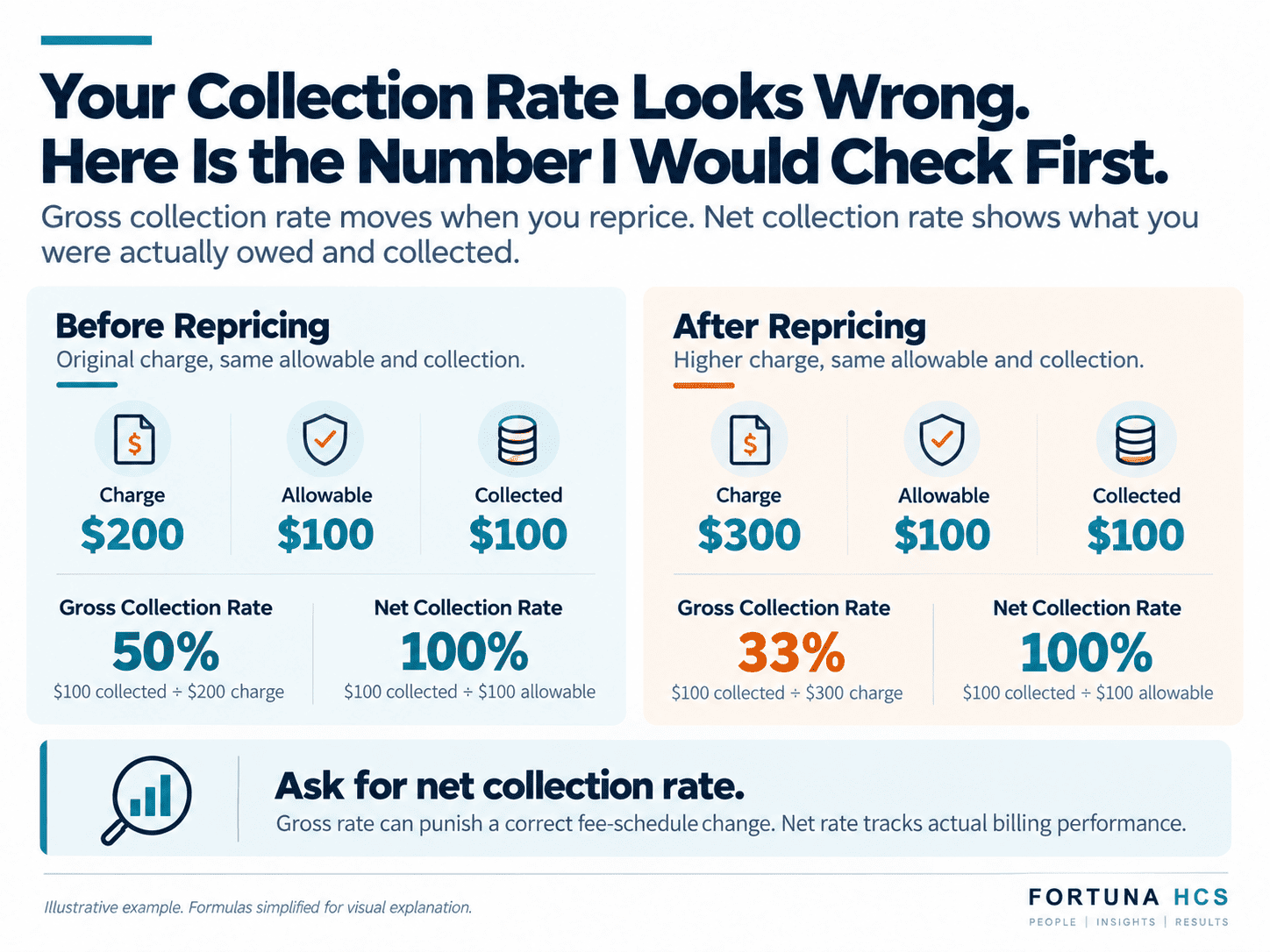
A Worked Example
Take a practice billing at twice the Medicare rate. A visit carries a charge of $200, the contracted allowable is $100, and the practice collects the full $100. Gross collection rate: 50%.
Now the practice reprices to three times Medicare. The same visit carries a charge of $300. The allowable has not changed — it is still $100, because that is what the contract says — and the practice still collects $100. Gross collection rate: 33%.
Nothing got worse. The practice collects exactly the same money for exactly the same work. On paper, performance appears to have collapsed by seventeen points.
This matters more than it sounds, because repricing is common and often correct. Practices raise fee schedules to protect against out-of-network reimbursement, to stop underbilling codes where the allowable exceeds the charge, or simply because the schedule has not been reviewed in a decade. All defensible. All of them wreck the gross collection rate.
What Net Collection Rate Measures Instead
Net collection rate is payments measured against what your payer contracts actually entitle you to collect. In formula terms:
| Net collection rate | = | (Payments − refunds) ÷ (Charges − contractual adjustments − payer withholds) |
The denominator is the important part. By stripping out contractual adjustments — the difference between what you billed and what the contract allows — you are left with the money you were actually owed. The ratio then answers a single question: of the money we were entitled to, how much did we get?
That number does not move when you reprice. It moves when your billing performance changes. Which is the entire point.
What good looks like
- 95% and above: a well-run revenue cycle. There is always some leakage; chasing the last two points usually costs more than it returns.
- 90 to 95%: functional, with identifiable problems. Usually denials, timely filing, or patient responsibility going uncollected.
- Below 90%: something structural. Find out what it is before adding volume, because growth multiplies the leak.
How to Work It Out Yourself
Most practice management systems will give you the components even if they do not calculate the ratio. In eClinicalWorks, report 36.14 — Financial Analysis at Claim Level — carries charges, payments, contractual adjustments, payer withholds and refunds in one extract.
Three things to get right when you run it:
- Group by transaction month, not service month. Payments arrive months after the visit. Mixing the two produces a number that means nothing.
- Use at least twelve months. A single month is noise — a large payment or a batch of adjustments will swing it ten points either way.
- Watch write-offs separately. Contractual adjustments are contractual. Write-offs are choices, and they are where avoidable losses hide.
The Practical Consequence
If you are benchmarking your practice, comparing quarters, or evaluating a billing company, gross collection rate will mislead you in both directions. It will make a repricing look like a collapse, and it will make an underbilled fee schedule look like excellent performance.
Ask for net collection rate. If the person reporting to you cannot produce it, or does not know the difference, that is itself the finding.
You do not need another report telling you that something is wrong. We help identify the operational cause, build the solution, and stay accountable for the result. The assessment fee is credited against your first invoice if you engage us.