

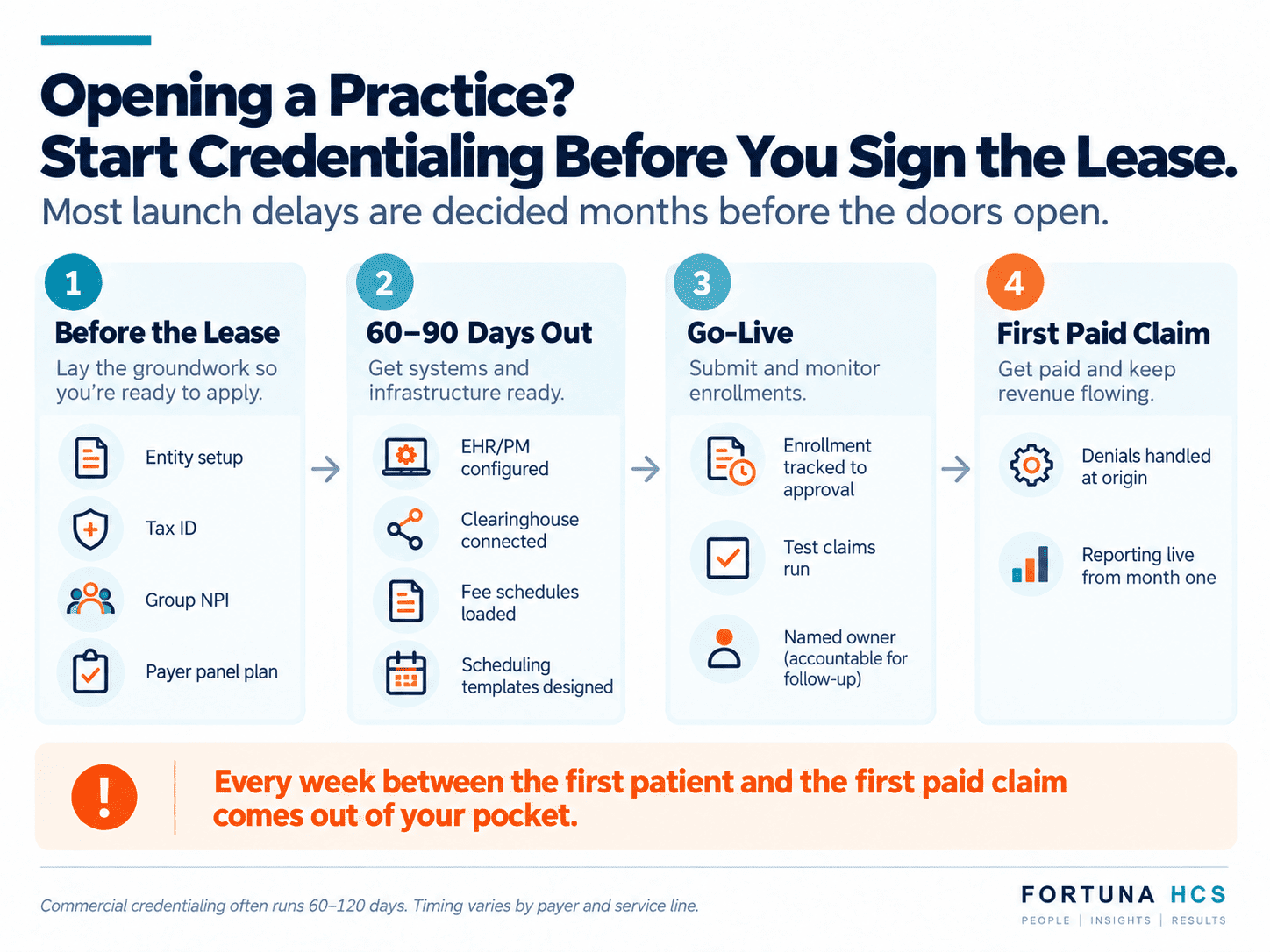
Every week between your first patient and your first paid claim comes out of your own pocket. Most of that delay is decided months before the doors open.
When a practice launch runs late, the reason given is usually construction, or equipment, or a contractor. Occasionally that is true. Far more often the build-out finished roughly on time and the practice still could not bill for three months.
The cause is sequencing. Certain things have to happen before other things can start, and the dependencies are not obvious unless you have run a launch before.
The Dependency That Catches Everyone
Payer enrollment cannot begin until the entity exists. You need the legal entity, the tax ID and the group NPI before an application can be submitted. Those take weeks to obtain.
Commercial credentialing commonly runs sixty to one hundred and twenty days, and that clock starts when the application is filed — not when you decided to open. Medicare typically runs forty-five to ninety days. Texas Medicaid typically takes thirty to ninety days, and the managed care plans cannot start until base Medicaid enrollment is active.
A practice that forms its entity when it signs the lease has already lost its first month, and will probably see patients it cannot bill for.
What Actually Goes Wrong
- Enrollment started after the lease. The most common single cause. Entity formation and enrollment should be running while the space is still being fitted out.
- A service line opened before credentialing was complete. The equipment arrived, the staff were trained, the schedule filled — and the claims were unbillable. Ancillary lines need their own enrollment, and each has its own timeline.
- The billing system was configured after go-live. Fee schedules loaded late, payer IDs wrong, rendering provider set up incorrectly. The first month of claims goes out wrong and comes back as rework.
- Nobody owned the launch full-time. The physician is seeing patients or finishing a notice period. The office manager was hired three weeks ago. The launch moves at the speed of whoever has a spare afternoon.
The Sequence That Works
Before the lease
Entity, tax ID, group NPI. Payer panel agreed and applications sequenced by expected volume, so the payers representing most of your revenue are submitted first. This is the step that protects the launch date.
Sixty to ninety days out
EHR and practice management configured, clearinghouse connected, fee schedules loaded, coding standards set. Scheduling templates, front-office workflow and the staffing model designed — before anyone is hired into them.
Go-Live
Enrollment tracked to approval dates rather than submission dates. Test claims run before the first real one. A named owner running a weekly cadence against a written plan.
First paid claim and beyond
Denials worked at the point of origin, A/R discipline from day one, reporting live from the first month rather than reconstructed later.
What a Week Costs
It is worth calculating before you plan the launch rather than after. Take projected monthly collections at steady state, divide by four, and that is roughly the cost of a week of delay — against a fixed cost base that is already running. Rent, salaries and equipment leases do not wait for credentialing.
For most practices the number is large enough that a few weeks of sequencing discipline at the start is the highest-return work in the entire project.
You do not need another report telling you that something is wrong. We help identify the operational cause, build the solution, and stay accountable for the result. The assessment fee is credited against your first invoice if you engage us.