

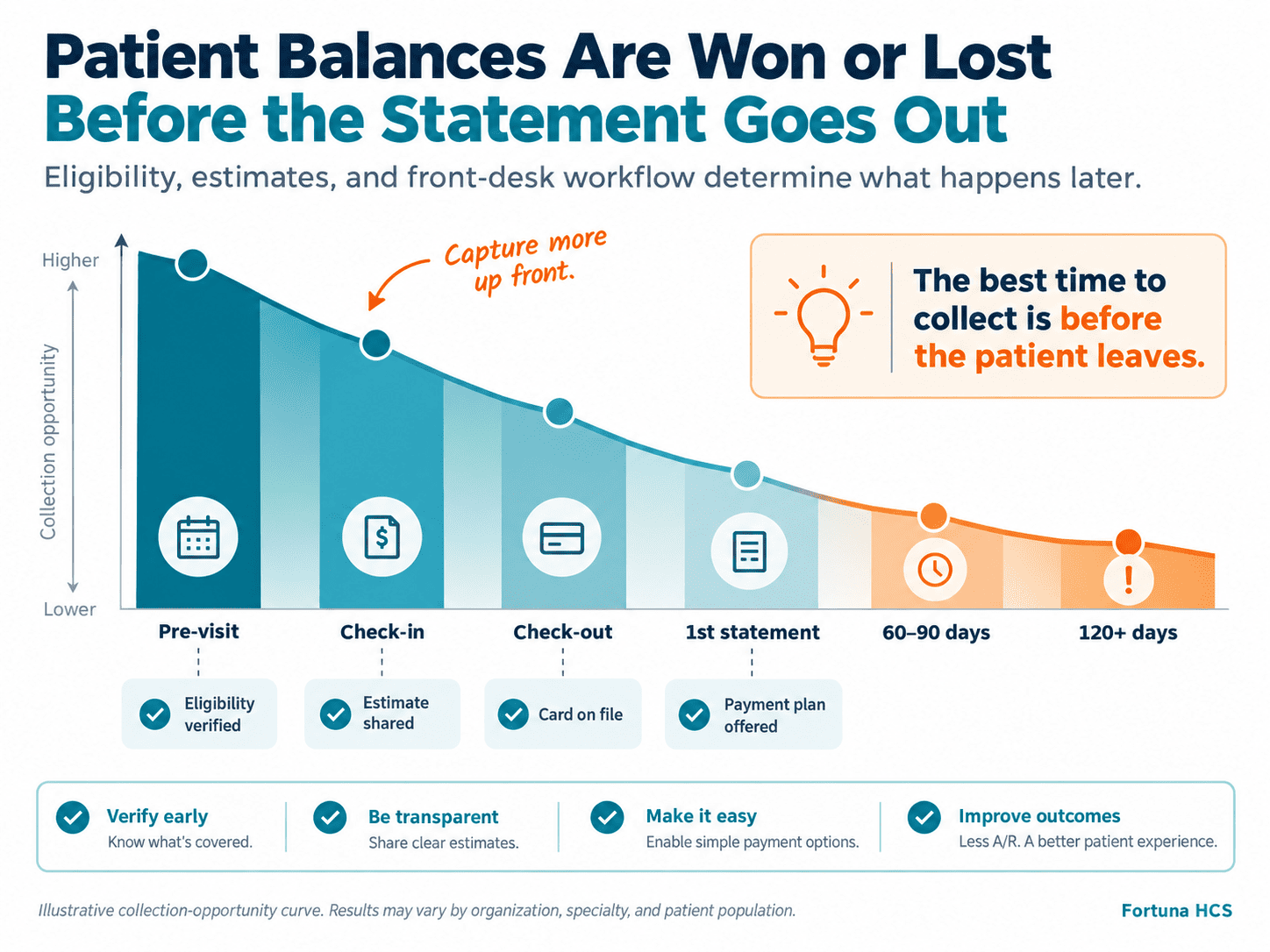
The best time to collect a patient balance is before the patient leaves. Eligibility, estimates and front-desk workflow determine what happens months later.
A growing share of practice revenue now sits in patient responsibility rather than payer responsibility. The billing operation that was built to chase insurers is being asked to collect from individuals, and it is a different job with different economics.
The central fact is timing. A balance is most collectible while the patient is in front of you, and the opportunity narrows with every week after that.
The Outcome Is Determined Before the Visit
- Eligibility checked with the deductible remaining, not just active coverage. Knowing a plan is active tells you nothing about who is paying for this visit.
- An estimate produced in advance for anything with a meaningful patient portion, so the amount is not a surprise at check-out.
- A card on file authorization, with clear consent for the amount that can be charged once the claim adjudicates.
- A script the front desk is comfortable using. Most staff will not ask for money unless they have been told exactly how, and told that it is expected.
- A payment plan offered at the first statement rather than the third. A balance on a plan is being collected; a balance on a fourth statement is being ignored.

The Statement Cycle Is Expensive
The sequence is the same in every practice: pre-visit, check-in, check-out, first statement, 60 to 90 days, 120 days and beyond. Everything before the patient walks out is a workflow you control. Everything after it is a collection effort with falling returns.
Once a balance moves into the statement cycle it costs money to pursue: printing, postage, staff time on calls, and eventually an agency taking a percentage of whatever is left. A balance collected at the desk costs almost nothing. The comparison is not between collecting now and collecting later. It is between collecting now and collecting a fraction later at a cost.
What to Measure
- Point-of-service collection rate: patient dollars collected at the visit as a share of patient responsibility for that visit.
- Patient A/R over 90 days, kept separate from payer A/R so neither distorts the other.
- Bad debt as a percentage of patient responsibility, reviewed quarterly.
A Word on Tone
Practices worry that asking for money at the desk damages the relationship. In our experience the opposite is closer to true. Patients react badly to surprise, not to being asked. A clear estimate before the visit and a consistent request at check-out produce fewer complaints than a statement arriving six weeks later for an amount nobody mentioned.
The Operator’s Check
| Measure: | Point-of-service collections as a share of patient responsibility for those visits |
| Owner: | Front office lead, with the practice administrator |
| Cadence: | Weekly |
| Red flag: | Patient A/R over 90 days growing while point-of-service collections stay flat |
You do not need another report telling you that something is wrong. We help identify the operational cause, build the solution, and stay accountable for the result. The assessment fee is credited against your first invoice if you engage us.